04 May, 2009

Zen & Physics

Eastern Philosophy

Photobucket

Zen Buddhism was developed in early China, from the interaction between Mahayana Buddhism and Taoism. Through meditation, Zen practitioners seek new perspectives and insights on existence, which ultimately lead to enlightenment. To truly understand others is to truly understand oneself, and vice-versa.
Buddhas don't save Buddhas. If you use your mind to look for a Buddha, you won't see the Buddha. As long as you look for a Buddha somewhere else, you'll never see that your own mind is the Buddha. Don't use a Buddha to worship a Buddha. And don't use the mind to invoke a Buddha. Buddhas don't recite sutras. Buddhas don't keep precepts. And Buddhas don't break precepts. Buddhas don't keep or break anything. Buddhas don't do good or evil.

To find a Buddha, you have to see your nature.

So, what is Zen?

The only true answer to that question, is the one that you find out for yourself.
A Hindu story tells of a fish who asked of another fish: "I have always heard about the sea, but what is it? Where is it?"

The other fish replied: "You live, move and have your being the sea. The sea is within you and without you, and you are made of sea, and you will end in sea. The sea surrounds you as your own being."
Let us try to further understand this concept. Many of the ideas in ancient Eastern philosophies, in one way or another, are very similiar to those in quantum physics. We'll see how they are related.

Bose-Einstein Condensate

Matter can exist in various states; solid, liquid or gas. Atoms at high temperature always form gases. If you cool the gas, it becomes a liquid. If you cool a liquid, it becomes a solid. But under certain circumstances, if you cool atoms far enough to extremely low temperatures, they undergo a very strange transformation. An identity crisis!

Imagine that atoms are like tiny dots. When you go to low temperatures, the quantum mechanics of the atoms become important. In fact, each of these atoms will start to display wave-like properties. They begin to stretch out like small wavy strings, moving around. Once you go into near absolute zero temperatures, the size of these wavy strings get longer and longer. Particles begin to slow down.

Photobucket

If you get them cold enough, they to start overlapping each other and merge. We can this the Bose-Einstein condensate. This unique state of matter was first proposed by Satyendra Nath Bose and Albert Einstein back in the 1920's.

The whole system does not behave like individual particles, because each have loss their identity and think they are everywhere at once. You can't tell whether they are here or there, or which one for that matter. Now, they are all just simply at rest. We don't consider individual particles anymore because they all form one big quantum system, all doing the same thing.

Easy science concept:
http://www.youtube.com/watch?v=bdzHnApHM9A

... continue reading

02 May, 2009

Ending the Age of Silicon

Just bought the most advanced laptop? Got a couple of terabytes in your hard-drives?
Well, you have seen nothing yet!

Photobucket

You should realize that in about 20 years time, Moore's Law is gonna collapse. We are looking at the End of the Silicon Age, and perhaps the beginning of a new generation of computers called quantum computers, which are now exciting the imagination of scientists around the world.

Note: To get a better understanding of this article, please read my previous post on Data Storage.

News-flash

Back in 2001, there was a scientific breakthrough that made the headlines, even the CIA took note of this. A quantum computer built with 7 atoms(qubits), proved that 3 times 5 equals 15. Surely, any kid knows that. But physicist were able to compute on just 7 atoms!

In recent years, physicist have been able to create a prototype 16-qubit quantum computer that touts immense computational power. Works are on the way to built a faster 1,000-qubit version which should be available anytime soon.

Now, think about this. Once we begin to compute on a few million atoms, we'll be able to break any code that the CIA or NSA can manufacture. This means that we'll could break any code currently in existence, on a quantum computer. Again, within 20-30 years. So don't hold your breath.

Wait a sec!

The physical laws operating on the quantum scale are different. Things such as Uncertainty comes into play. Isn't it difficult to produce something that is stable. Well, that's precisely why we'll see the End of the Silicon Age, perhaps in 20 years. Here's an example:
A Pentium chip's thinnest layer is about 20 atoms across. In 15-20 years, the thinnest layer in the Pentium chip will be about 5 atoms across. At that point, you don't really know where the electrons is anymore. the electrons could be outside or inside the wire. You have the Uncertainty Principle. In other words, you get a short circuit.

Therefore, silicon(Si) is unstable at the quantum level. You can't sustain Moore's Law continually forever. And yet quantum computers operates at that level, what is it doing that's different?

Quantum computers consist totally of atoms, that are arranged in a sequence and each spins like a top. If you shoot laser beams or radio waves at them, you get the reflection. By analyzing these reflections, you have done a quantum calculation, faster than any known digital computer.

Photobucket

So, what's in it for us?

Once we start to mass produce quantum computers, we'll be able to utilized super-strong encryption designed with hacker-proof security for communications. Quantum encryption will represent the first major commercial implementation for this new technology.

As for the software we use, no changes will be necessary. You just need a software emulator, such as those that allow Windows software on the Macintosh computer. An emulator for quantum computers could quite easily run any programs today at speeds will that put today’s fastest processors to shame.

It may also change the way we do computing. Users would only need to be connected to share a large, centralized quantum computer – one that has the capacity to handle quadrillions of transactions. Personal data – a whole lifetimes worth – could be stored on a quantum USB-type memory the size of a credit card. This would effective eliminate the need to have millions of PCs that require upgrading every few years.


Press info:
http://domino.research.ibm.com/comm/pr.nsf/pages/news.20011219_quantum.html
http://thefutureofthings.com/pod/165/first-quantum-computer-demonstrated.html
http://www.gizmowatch.com/entry/worlds-first-quantum-computer-announced-officially

... continue reading

23 March, 2009

Real Teleportation

Teleportation has long since been the stuff of science fiction.


The ability to transfer properties of one particle to another without using any physical link has been achieved with laser light. When physicists talk about "teleportation", they are describing the transfer of "quantum states" between separate atoms. Being able to do the same with massive particles like atoms could lead to new superfast computers.

Achievements


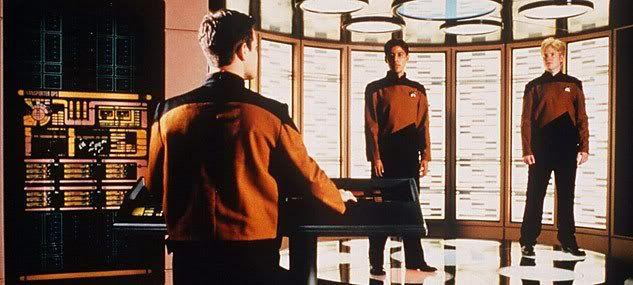
So far, physicists have been successful in teleporting particles of light (photons), individual atoms of Caesium (Cs) and Beryllium (Be) up to 100 miles. The next phase is to teleport an atom through the vacuum of space. In a few decades, we may be able to send a molecule, DNA, a virus, or even a living cell. This development is a long way from the transporters seen in Star Trek. We need to wait a few more centuries.

Note: An average human adult body is made up of 50~100 trillion cells.

Our assumption

The classical idea of teleportation is the one method that we are used to. An object disassembles into particles, excites those particles and transfers them at high speeds, then reach the location and each individual particle reassembles back to form a complete object. Which is almost impossible, seeing that the process would required exponentially huge amount of energy, and it's time consuming.

The real thing

What physicists are applying is something known as Quantum teleportation. Each particles in an object has it's own counterparts that have the same properties but also exist in a different space. This is called the Entanglement phenomenon, one of the weirdest scientific mysteries. So in theory, we actually transfer the information of a particle such as temperature, mass, colour, etc.
Quantum entanglement is a quantum mechanical phenomenon in which the quantum states of two or more objects are linked together so that one object can no longer be adequately described without full mention of its counterpart — even though the individual objects may be spatially separated.

Try to imagine

Two electrons exist in different locations but exist in the same frequency, hence they are essentially identical. Like two balls attached to a vibrating string, except one ball that you are holding is "Real" and the ball at the other end is "Imaginary". When you destroy the "Real" ball, the information from the "Real" ball is tranferred to the "Imaginary" ball via the vibrating string. Thus the "Imaginary" ball is now an exact copy of the "Real" ball.

At first, it may sound a photo-copying. But the original does not exist anymore.
The "Imaginary" ball before is now becomes the "Real" ball.


Teleporting an apple with near-impossible even with the Quantum entanglement stuff.
The best with could do is to teleport small amount of data via photons. Let's assume we have achieved Quantum teleportation for human beings. You can teleport from home to office.

Now here's the catch

Ask yourself, are you still you? After you teleport, you're not in your original body anymore, because the original copy is destroyed. You may feel and think the same but your atomic make-up is different. Are you still human when your body is not the original? Can consciousness be teleported? More food for thought.

Personal thoughts

I would like to see the day when I could go to different places in a blink of an eye, but that would not happen in our lifetime. Though I may not be able to experience teleportation, I'm proud to belong to the generation that invented it. Ok, beam me up. Scottie!

Short videos:
http://www.youtube.com/watch?v=3nq6y9P1_yM
http://www.youtube.com/watch?v=G5poD3nXdJ8

... continue reading