18 April, 2009

QR Code

Have you seen something like this before?


If it looks familiar, you have probably seen it on a product packaging.

This is a QR Code. A sort of matrix code or 2D bar code created by Japanese corporation Denso-Wave in 1994. It is named "QR" short for "Quick Response", as it was created to be decoded at high speed.

Another quirky invention of the Japanese?

Why not stick with using bar codes?

As we all know, bar codes are widely popular because of their reading speed, accuracy, and superior functionality. As bar codes became popular and their convenience universally recognized, the market began to look for new ways of storing more information, and could be printed in a smaller space. As a result, the QR code was born!

It then became an instant hit with the Japanese popular culture. Most current Japanese mobile phones can read this code with their camera. QR Codes are now used in a much broader applications, including commercial tracking and convenience-oriented servives aimed at mobile phone users.

QR Codes can store addresses, URLs, emails, phone numbers, SMS text message, and many other functions. These codes are usually printed in magazines, on signs, buses, business cards or on any products that users might need information about. Users with a camera phone equipped with the correct software can scan the image of the QR Code.

Here's a tool to create your own custom QR code: QR-Code Generator
Download and install this QR-Code Reader onto your mobile phone.

PS: Try decoding the above image with your own camera phone. Yes, it even works on LCD screens! Special thanks to Dominic for the reader links.

... continue reading

23 March, 2009

Real Teleportation

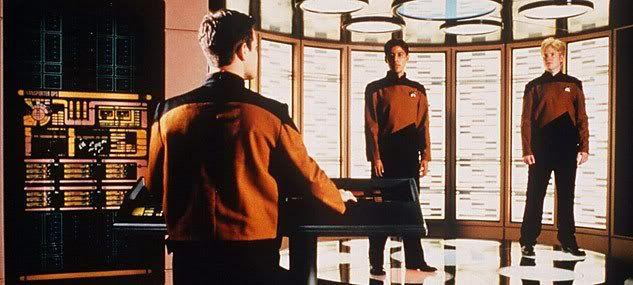
Teleportation has long since been the stuff of science fiction.


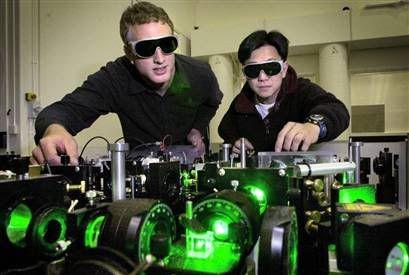
The ability to transfer properties of one particle to another without using any physical link has been achieved with laser light. When physicists talk about "teleportation", they are describing the transfer of "quantum states" between separate atoms. Being able to do the same with massive particles like atoms could lead to new superfast computers.

Achievements


So far, physicists have been successful in teleporting particles of light (photons), individual atoms of Caesium (Cs) and Beryllium (Be) up to 100 miles. The next phase is to teleport an atom through the vacuum of space. In a few decades, we may be able to send a molecule, DNA, a virus, or even a living cell. This development is a long way from the transporters seen in Star Trek. We need to wait a few more centuries.

Note: An average human adult body is made up of 50~100 trillion cells.

Our assumption

The classical idea of teleportation is the one method that we are used to. An object disassembles into particles, excites those particles and transfers them at high speeds, then reach the location and each individual particle reassembles back to form a complete object. Which is almost impossible, seeing that the process would required exponentially huge amount of energy, and it's time consuming.

The real thing

What physicists are applying is something known as Quantum teleportation. Each particles in an object has it's own counterparts that have the same properties but also exist in a different space. This is called the Entanglement phenomenon, one of the weirdest scientific mysteries. So in theory, we actually transfer the information of a particle such as temperature, mass, colour, etc.
Quantum entanglement is a quantum mechanical phenomenon in which the quantum states of two or more objects are linked together so that one object can no longer be adequately described without full mention of its counterpart — even though the individual objects may be spatially separated.

Try to imagine

Two electrons exist in different locations but exist in the same frequency, hence they are essentially identical. Like two balls attached to a vibrating string, except one ball that you are holding is "Real" and the ball at the other end is "Imaginary". When you destroy the "Real" ball, the information from the "Real" ball is tranferred to the "Imaginary" ball via the vibrating string. Thus the "Imaginary" ball is now an exact copy of the "Real" ball.

At first, it may sound a photo-copying. But the original does not exist anymore.
The "Imaginary" ball before is now becomes the "Real" ball.


Teleporting an apple with near-impossible even with the Quantum entanglement stuff.
The best with could do is to teleport small amount of data via photons. Let's assume we have achieved Quantum teleportation for human beings. You can teleport from home to office.

Now here's the catch

Ask yourself, are you still you? After you teleport, you're not in your original body anymore, because the original copy is destroyed. You may feel and think the same but your atomic make-up is different. Are you still human when your body is not the original? Can consciousness be teleported? More food for thought.

Personal thoughts

I would like to see the day when I could go to different places in a blink of an eye, but that would not happen in our lifetime. Though I may not be able to experience teleportation, I'm proud to belong to the generation that invented it. Ok, beam me up. Scottie!

Short videos:
http://www.youtube.com/watch?v=3nq6y9P1_yM
http://www.youtube.com/watch?v=G5poD3nXdJ8

... continue reading