21 May, 2009

Your very own mecha musume?

Ever want your own android?
Well, someone already started making one of his own.

Photobucket

Inventor Le Trung, 33, created Aiko, said to be "in her 20s" with a stunning 82, 57, 84 figure, shiny hair and delicate features. 'She' even remembers his favourite drink and does simple cleaning and household tasks.

Aiko is the first android to react to physical stimuli and mimic pain. This technology could be applied to people born with or who have undergone amputations. Aiko is the first step towards a life-like mechanical limb that has the ability to feel physical sensations.

I started to build Aiko on August 15, 2007. About a month and a half later, Aiko version1 was completed. Aiko made her first public appearance at the Hobby Show on November 2007 at the Toronto International Center and then at the Ontario Science Center a week later. Aiko is currently bilingual and can speak English and Japanese. Additional languages are a future possibility...
Demos:
http://www.youtube.com/watch?v=5itAZybggVM
http://www.youtube.com/watch?v=yomx7bXMf2U
http://www.youtube.com/watch?v=tJLMeS2Y8LY


The Project was officially started in 2007 in order to pursue robotic automation. Le is responsible for the robot's core AI logic, internal software, hardware innovations derived from years of building robots as a hobby. He designed and developed the key B.R.A.I.N.S software that gives the android its capability to interact with humans.

Aiko - AI Female Android:
  • Speech, Reading, Color, Face, Object recognition
  • Ability to tell Weather
  • Ability to have a conversation
  • Can understand 13,000+ sentences
  • has the ability to learn
  • Ability to solve math
  • Ability to distinguish simple drinks and foods
  • Mimic human physical touch
Construction:
http://www.youtube.com/watch?v=iCR2PFrLkwA
http://www.youtube.com/watch?v=ZPMXPMeh7KY


Can our local techies achieve this level of l33tness?!
We could, but we have been slugging away too long.
The future is sure gonna be a epic.

More updates at the Project Aiko blog.

... continue reading

01 May, 2009

Giant Kabuto Mushi Mecha

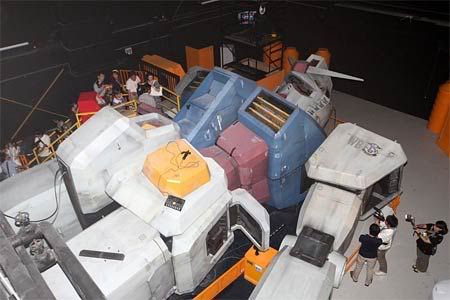
Bow down to the greatest creation of all otaku-kind! A workable giant beetle robot modeled after the rhinoceros beetle. It's the stuff of every boy's fantasy. Better still, you could ride and control it from the cockpit. Imagine if this comes crashing down the highway.


Designed and built by an Ibaraki man in his garage over the course of eleven years, the “Kabutom MX-03″ looks like a prop from a Power Rangers spin-off but is an actual working vehicle. Why build it? Because owning an eleven meter long, fifteen ton robot beetle makes you a mack daddy — in Japan or anywhere else.

And who knows, maybe somewhere around the world, someone is building a 30-feet Gundam in their backyard. Looking forward to it :)


More info:
http://altjapan.typepad.com/my_weblog/2009/04/mushi-mecha.html
http://www.youtube.com/watch?v=Kf7Sytl2-EE

PS: Mechanical engineering rules!

... continue reading

Revolution of Data Storage

What will be the future of DVDs?

We are already adopting Blu-Ray and HD-DVD formats. Storage space for hard-drives has reached the terabyte (TB) mark. So what else is new? There's a limit to how much data you can store on a disk. I doubt that the magnetic and optical data storage that we use today would continue to exist in the future.

Well, what about flash-drives? They are solid-state, silicone-based storage but there's also a limit to this technology. Every year, your flash-drives (pen/thumb-drives) can store almost twice as much as they were the previous year. This can't go on forever, because Moore's Law isn't sustainable as believed.

Holographics: The next step

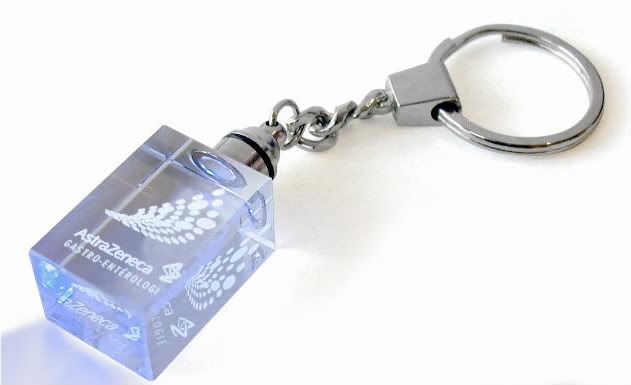
Envision the day where all data will be stored in crystals/crystalline materials. In the future, we will need to store data of times past for times ahead, lots of it. CD's and DVD's will rot, data formats will become unreadable, new technologies are needed.

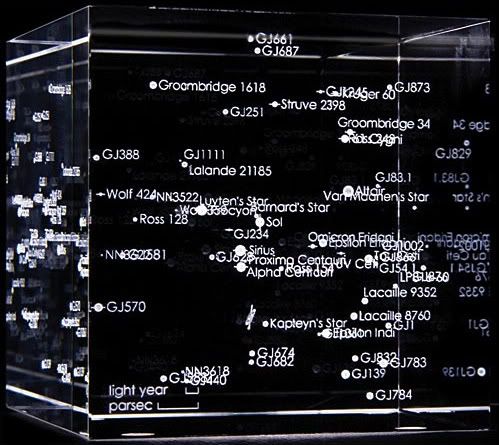
Holographic crystals can store up to 200 DVD's worth of information for up to 1000 years as digits or as microscopic images. Data could be etched into these small crystals using a highly-tuned precision laser.


How it works?

Magnetic and optical data storage works by having individual bits being stored as distinct changes on the (2D) surface of the recording medium. This only records information a bit at a time in a linear fashion.

Holographic data storage records information throughout the (3D) volume of the medium. This enables it to record multiple images in the same area utilizing light at different angles. Holographic storage is capable of reading and writing millions of bits in parallel, giving faster data transfer rates.


See also:
http://www.youtube.com/watch?v=R-NllWcgrFg

... continue reading

18 April, 2009

QR Code

Have you seen something like this before?


If it looks familiar, you have probably seen it on a product packaging.

This is a QR Code. A sort of matrix code or 2D bar code created by Japanese corporation Denso-Wave in 1994. It is named "QR" short for "Quick Response", as it was created to be decoded at high speed.

Another quirky invention of the Japanese?

Why not stick with using bar codes?

As we all know, bar codes are widely popular because of their reading speed, accuracy, and superior functionality. As bar codes became popular and their convenience universally recognized, the market began to look for new ways of storing more information, and could be printed in a smaller space. As a result, the QR code was born!

It then became an instant hit with the Japanese popular culture. Most current Japanese mobile phones can read this code with their camera. QR Codes are now used in a much broader applications, including commercial tracking and convenience-oriented servives aimed at mobile phone users.

QR Codes can store addresses, URLs, emails, phone numbers, SMS text message, and many other functions. These codes are usually printed in magazines, on signs, buses, business cards or on any products that users might need information about. Users with a camera phone equipped with the correct software can scan the image of the QR Code.

Here's a tool to create your own custom QR code: QR-Code Generator
Download and install this QR-Code Reader onto your mobile phone.

PS: Try decoding the above image with your own camera phone. Yes, it even works on LCD screens! Special thanks to Dominic for the reader links.

... continue reading

13 March, 2009

World's Earliest Computer, After 2000 Years

This was a hot topic for engineers and historians a few months back. The device mentioned is officially known as the Antikythera mechanism.


Its discovery has puzzled many historians of science and technology. Prompting a number of experts worldwide to undertake a systematic investigation of the mechanism. The investigators suggest that the device may be of Syracusan design, and may have a connection to the works of Archimedes.


The abacus may still hold claim as the earliest computer. However, the abacus is only simple calculating tool when compare to the complexity of Antikythera mechanism.

The Antikythera mechanism is an ancient mechanical calculator (also the first known mechanical computer) designed to calculate astronomical positions or movements of the planets. It was a precision engineered device, that could be programmed by the user. The device appears to be constructed using theories of astronomy and mathematics developed by Greek astronomers.

Here's the modern recontruction of the world's first analog computer. (IT guys take note!)


See the video:
http://www.youtube.com/watch?v=ZrfMFhrgOFc

Ponder on all these for a while; you will come to realize that the people of ancient civilizations are much smarter than we credited them with. The only reasons they aren't as successful as us, is because they live in the time of civil and religious wars, superstition, and rampant diseases.

Also visit:
Antikythera Mechanism Research Project

... continue reading

02 March, 2009

Looking for Other Intelligent Life?

You guys have probably heard of the SETI programme, seen countless UFO stuff, Hollywood movies, government conspiracy theories, and experienced general paranoia. Instead of readily believing these so-called facts. Let us analyze the science behind the search for aliens in outer space.

Photobucket

Note: Too better understand this article, please read my previous post on Civilizations.

Why not getting any response?

The mathematics of Drake Equation shows that there should be millions of alien civilizations already in outer space. But why can't we find any evidence of these Type I, II, and III civilizations? Perhaps, they didn't make it to Type I. Maybe they are similar to us; waging war and destroying themselves.

If extraterrestrial civilizations do survive their Transition from Type 0 to Type I, where the heck are they? We have been scanning the skies for decades. Why are they not replying to our message signals?

First argument: Let's assume that Type I, II, and III civilizations have the mastery of hyperspatial travel. This implies that their level of science is millions (or thousands) of years more advance than ours. In human terms, it's not like comparing 21th century to 14th century; it's more like comparing 30th century to ape-men (approx 1.4 million years ago).

Second argument: These advance beings wouldn't even bother with us primitive humans. To them, we are just idiotic beings still fighting over silly things like petroleum and religion. We are too proud to think that an advance civilization would just stop they daily business, drop by and send us a greeting.

Let's put this into perspective: Would you tell an ant? "I brought you gifts of Wi-Fi, laser beams, and computer technology. Now, bring me to your leader". No, you'll instead feel like squishing them. More so, if you build a highway beside an ant-hill, would the ants realize that you are building a highway? Do the ants even know what a highway is?

Third argument: Never underestimate the technology of others. The people at SETI are misguided. Why would an advance civilization contact us with just using infra-red, or microwave signals? And why are SETI people listening on electromagnetic frequencies base on the hydrogen atom? There are supernovas, asteroid belts, and black holes that could distort all these signals.

When you send an email, the message would be encrypted, chopped-up, relayed through a series of servers, and combined back to one piece when it's reaches the recipient. And to make sure your friend gets the message, you could send an SMS, IM, or even snail-mail to him/her.

Now, a smart civilization would also relay messages using similar methods. To make sure their messages reach the destination, they would encrypt it and send it thru an array of frequencies. If you only scan and translate a part of it, you'll get only gibberish.

Personal thoughts

Photobucket

Whether or not other intelligent life exist? That is still up for debate. I believe that they do exist, regardless of what the critics says. Otherwise, wouldn't it be sad to think that we are all alone in this infinitely vast universe?

But don't put too much hope into meeting ET's anytime soon in your lifetime. If intelligent life do exist in the far reaches of space, it will be in a couple millions years before we get our first contact. That's when humanity finally rids itself of senseless conflicts.

More info: http://www.mkaku.org/

... continue reading