21 May, 2009

The Zeroth Law of Robotics

If you have read Isaac Asimov's novels, then you're familiar with the Three Laws of Robotics. The reason the Laws are conceive is to curb the potential for robots to harm people.

Asimov once added a "Zeroth Law", stating that a robot must not merely act in the interests of individual humans, but of all humanity. Unknown to many, unless you are a great fan of his novels :)
The original Laws of Robotics (1940)
by Isaac Asimov, 20

First Law:
A robot may not injure a human being, or, through inaction, allow a human being to come to harm.

Second Law:
A robot must obey orders given it by human beings, except where such orders would conflict with the First Law.

Third Law:
A robot must protect its own existence as long as such protection does not conflict with the First or Second Law.

For those of you who didn't know, I.Robot the Movie is not from the original Asimov's novels. The I.Robot novel is actually a compilation of short stories. The only thing
similar were title and the Three Laws.

In the movie, the robots were controlled by a huge super-computer that could violate the 1st Law. The computer's A.I. had come to a conclusion that to protect all humans, a few humans have to be sacrifice for the greater good. This is because the A.I. has allowed the Zeroth Law of Robotics.

Here are some excerpts from the novels:

Robots and Empire
In the final scenes, R. Giskard Reventlov is the first robot to act according to the Zeroth Law, although it proves destructive to his positronic brain, as he is not certain as to whether his choice will turn out to be for the ultimate good of humanity or not.

Giskard is telepathic, and he comes to his understanding of the Zeroth Law through his understanding of a more subtle concept of "harm" than most robots can grasp. Giskard grasps the philosophical concept of the Zeroth Law, allowing him to harm individual human beings if he can do so in service to the abstract concept of humanity.

The Zeroth Law is never programmed into Giskard's brain, but instead is a rule he attempts to rationalize through pure metacognition; though he fails, he gives his successor, R. Daneel Olivaw, his telepathic abilities. Over the course of many thousand years, Daneel adapts himself to be able to fully obey the Zeroth Law.

Foundation and Earth
and Prelude to Foundation
As Daneel formulates it, the Zeroth Law reads: "A robot may not harm humanity, or, by inaction, allow humanity to come to harm." A condition stating that the Zeroth Law must not be broken was added to the original Laws.

The Caves of Steel
Near the climax, Elijah Baley makes a bitter comment to himself, thinking that the First Law forbids a robot from harming a human being, unless the robot is clever enough to rationalize that its actions are for the human's long-term good (here meaning the specific human that must be harmed).

This reads, "A robot may not harm a human being, unless he finds a way to prove that in the final analysis, the harm done would benefit humanity in general."


... continue reading

03 May, 2009

Foresight

Humanoid robots, teleportation, anti-matter, hyper-space, worm holess, artificial intelligence, parallel universes, higher dimensions, animal hybrids, cyborgs, immortality, ESP, time travel.

Sound like badly written science fiction? Fret not! This is modern science. Things like these are constantly being investigated, discovered, researched at laboratories and institutions worldwide.

Photobucket

Decades ago, talking about stuff such as parallel universes and time travel, guarantees you instant career suicide. But with increasing global recognition, scientists now have the freedom to testing the boundaries of our imagination, and their papers are subjected to serious peer reviews.

Things like worm-holes and cyborgs now belong to the realm of scientific facts. What we have achieve is only on the tip of the iceberg. Science as we know it, is only in its infancy. And there are better things to come, but not all in our lifetime. So, don't start your bets yet.

I usually spend my time scouring through reports from scientific community for any exciting news. Much of my blog will be dedicated to these latest on-goings. Breaking-down complex ideas into digestible bits for you readers (if I'm free, though).

That's all for now.
Zooming out~!

... continue reading

02 May, 2009

Ending the Age of Silicon

Just bought the most advanced laptop? Got a couple of terabytes in your hard-drives?
Well, you have seen nothing yet!

Photobucket

You should realize that in about 20 years time, Moore's Law is gonna collapse. We are looking at the End of the Silicon Age, and perhaps the beginning of a new generation of computers called quantum computers, which are now exciting the imagination of scientists around the world.

Note: To get a better understanding of this article, please read my previous post on Data Storage.

News-flash

Back in 2001, there was a scientific breakthrough that made the headlines, even the CIA took note of this. A quantum computer built with 7 atoms(qubits), proved that 3 times 5 equals 15. Surely, any kid knows that. But physicist were able to compute on just 7 atoms!

In recent years, physicist have been able to create a prototype 16-qubit quantum computer that touts immense computational power. Works are on the way to built a faster 1,000-qubit version which should be available anytime soon.

Now, think about this. Once we begin to compute on a few million atoms, we'll be able to break any code that the CIA or NSA can manufacture. This means that we'll could break any code currently in existence, on a quantum computer. Again, within 20-30 years. So don't hold your breath.

Wait a sec!

The physical laws operating on the quantum scale are different. Things such as Uncertainty comes into play. Isn't it difficult to produce something that is stable. Well, that's precisely why we'll see the End of the Silicon Age, perhaps in 20 years. Here's an example:
A Pentium chip's thinnest layer is about 20 atoms across. In 15-20 years, the thinnest layer in the Pentium chip will be about 5 atoms across. At that point, you don't really know where the electrons is anymore. the electrons could be outside or inside the wire. You have the Uncertainty Principle. In other words, you get a short circuit.

Therefore, silicon(Si) is unstable at the quantum level. You can't sustain Moore's Law continually forever. And yet quantum computers operates at that level, what is it doing that's different?

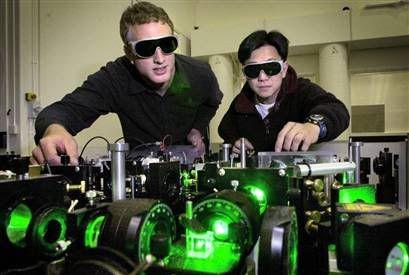
Quantum computers consist totally of atoms, that are arranged in a sequence and each spins like a top. If you shoot laser beams or radio waves at them, you get the reflection. By analyzing these reflections, you have done a quantum calculation, faster than any known digital computer.

Photobucket

So, what's in it for us?

Once we start to mass produce quantum computers, we'll be able to utilized super-strong encryption designed with hacker-proof security for communications. Quantum encryption will represent the first major commercial implementation for this new technology.

As for the software we use, no changes will be necessary. You just need a software emulator, such as those that allow Windows software on the Macintosh computer. An emulator for quantum computers could quite easily run any programs today at speeds will that put today’s fastest processors to shame.

It may also change the way we do computing. Users would only need to be connected to share a large, centralized quantum computer – one that has the capacity to handle quadrillions of transactions. Personal data – a whole lifetimes worth – could be stored on a quantum USB-type memory the size of a credit card. This would effective eliminate the need to have millions of PCs that require upgrading every few years.


Press info:
http://domino.research.ibm.com/comm/pr.nsf/pages/news.20011219_quantum.html
http://thefutureofthings.com/pod/165/first-quantum-computer-demonstrated.html
http://www.gizmowatch.com/entry/worlds-first-quantum-computer-announced-officially

... continue reading

01 May, 2009

Revolution of Data Storage

What will be the future of DVDs?

We are already adopting Blu-Ray and HD-DVD formats. Storage space for hard-drives has reached the terabyte (TB) mark. So what else is new? There's a limit to how much data you can store on a disk. I doubt that the magnetic and optical data storage that we use today would continue to exist in the future.

Well, what about flash-drives? They are solid-state, silicone-based storage but there's also a limit to this technology. Every year, your flash-drives (pen/thumb-drives) can store almost twice as much as they were the previous year. This can't go on forever, because Moore's Law isn't sustainable as believed.

Holographics: The next step

Envision the day where all data will be stored in crystals/crystalline materials. In the future, we will need to store data of times past for times ahead, lots of it. CD's and DVD's will rot, data formats will become unreadable, new technologies are needed.

Holographic crystals can store up to 200 DVD's worth of information for up to 1000 years as digits or as microscopic images. Data could be etched into these small crystals using a highly-tuned precision laser.


How it works?

Magnetic and optical data storage works by having individual bits being stored as distinct changes on the (2D) surface of the recording medium. This only records information a bit at a time in a linear fashion.

Holographic data storage records information throughout the (3D) volume of the medium. This enables it to record multiple images in the same area utilizing light at different angles. Holographic storage is capable of reading and writing millions of bits in parallel, giving faster data transfer rates.


See also:
http://www.youtube.com/watch?v=R-NllWcgrFg

... continue reading

23 March, 2009

Real Teleportation

Teleportation has long since been the stuff of science fiction.


The ability to transfer properties of one particle to another without using any physical link has been achieved with laser light. When physicists talk about "teleportation", they are describing the transfer of "quantum states" between separate atoms. Being able to do the same with massive particles like atoms could lead to new superfast computers.

Achievements


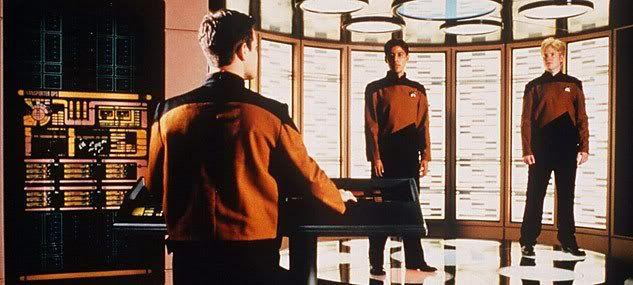
So far, physicists have been successful in teleporting particles of light (photons), individual atoms of Caesium (Cs) and Beryllium (Be) up to 100 miles. The next phase is to teleport an atom through the vacuum of space. In a few decades, we may be able to send a molecule, DNA, a virus, or even a living cell. This development is a long way from the transporters seen in Star Trek. We need to wait a few more centuries.

Note: An average human adult body is made up of 50~100 trillion cells.

Our assumption

The classical idea of teleportation is the one method that we are used to. An object disassembles into particles, excites those particles and transfers them at high speeds, then reach the location and each individual particle reassembles back to form a complete object. Which is almost impossible, seeing that the process would required exponentially huge amount of energy, and it's time consuming.

The real thing

What physicists are applying is something known as Quantum teleportation. Each particles in an object has it's own counterparts that have the same properties but also exist in a different space. This is called the Entanglement phenomenon, one of the weirdest scientific mysteries. So in theory, we actually transfer the information of a particle such as temperature, mass, colour, etc.
Quantum entanglement is a quantum mechanical phenomenon in which the quantum states of two or more objects are linked together so that one object can no longer be adequately described without full mention of its counterpart — even though the individual objects may be spatially separated.

Try to imagine

Two electrons exist in different locations but exist in the same frequency, hence they are essentially identical. Like two balls attached to a vibrating string, except one ball that you are holding is "Real" and the ball at the other end is "Imaginary". When you destroy the "Real" ball, the information from the "Real" ball is tranferred to the "Imaginary" ball via the vibrating string. Thus the "Imaginary" ball is now an exact copy of the "Real" ball.

At first, it may sound a photo-copying. But the original does not exist anymore.
The "Imaginary" ball before is now becomes the "Real" ball.


Teleporting an apple with near-impossible even with the Quantum entanglement stuff.
The best with could do is to teleport small amount of data via photons. Let's assume we have achieved Quantum teleportation for human beings. You can teleport from home to office.

Now here's the catch

Ask yourself, are you still you? After you teleport, you're not in your original body anymore, because the original copy is destroyed. You may feel and think the same but your atomic make-up is different. Are you still human when your body is not the original? Can consciousness be teleported? More food for thought.

Personal thoughts

I would like to see the day when I could go to different places in a blink of an eye, but that would not happen in our lifetime. Though I may not be able to experience teleportation, I'm proud to belong to the generation that invented it. Ok, beam me up. Scottie!

Short videos:
http://www.youtube.com/watch?v=3nq6y9P1_yM
http://www.youtube.com/watch?v=G5poD3nXdJ8

... continue reading

02 March, 2009

Looking for Other Intelligent Life?

You guys have probably heard of the SETI programme, seen countless UFO stuff, Hollywood movies, government conspiracy theories, and experienced general paranoia. Instead of readily believing these so-called facts. Let us analyze the science behind the search for aliens in outer space.

Photobucket

Note: Too better understand this article, please read my previous post on Civilizations.

Why not getting any response?

The mathematics of Drake Equation shows that there should be millions of alien civilizations already in outer space. But why can't we find any evidence of these Type I, II, and III civilizations? Perhaps, they didn't make it to Type I. Maybe they are similar to us; waging war and destroying themselves.

If extraterrestrial civilizations do survive their Transition from Type 0 to Type I, where the heck are they? We have been scanning the skies for decades. Why are they not replying to our message signals?

First argument: Let's assume that Type I, II, and III civilizations have the mastery of hyperspatial travel. This implies that their level of science is millions (or thousands) of years more advance than ours. In human terms, it's not like comparing 21th century to 14th century; it's more like comparing 30th century to ape-men (approx 1.4 million years ago).

Second argument: These advance beings wouldn't even bother with us primitive humans. To them, we are just idiotic beings still fighting over silly things like petroleum and religion. We are too proud to think that an advance civilization would just stop they daily business, drop by and send us a greeting.

Let's put this into perspective: Would you tell an ant? "I brought you gifts of Wi-Fi, laser beams, and computer technology. Now, bring me to your leader". No, you'll instead feel like squishing them. More so, if you build a highway beside an ant-hill, would the ants realize that you are building a highway? Do the ants even know what a highway is?

Third argument: Never underestimate the technology of others. The people at SETI are misguided. Why would an advance civilization contact us with just using infra-red, or microwave signals? And why are SETI people listening on electromagnetic frequencies base on the hydrogen atom? There are supernovas, asteroid belts, and black holes that could distort all these signals.

When you send an email, the message would be encrypted, chopped-up, relayed through a series of servers, and combined back to one piece when it's reaches the recipient. And to make sure your friend gets the message, you could send an SMS, IM, or even snail-mail to him/her.

Now, a smart civilization would also relay messages using similar methods. To make sure their messages reach the destination, they would encrypt it and send it thru an array of frequencies. If you only scan and translate a part of it, you'll get only gibberish.

Personal thoughts

Photobucket

Whether or not other intelligent life exist? That is still up for debate. I believe that they do exist, regardless of what the critics says. Otherwise, wouldn't it be sad to think that we are all alone in this infinitely vast universe?

But don't put too much hope into meeting ET's anytime soon in your lifetime. If intelligent life do exist in the far reaches of space, it will be in a couple millions years before we get our first contact. That's when humanity finally rids itself of senseless conflicts.

More info: http://www.mkaku.org/

... continue reading