31 May, 2009

Distance of Lighting Strike

Photobucket

A thunderstorm is approaching, and suddenly you hear an absolutely deafening clap of thunder. At times it becomes frightening! But how close is the lightning, really?

It is difficult to determine the distance of a lightning bolt just by looking at it, and the volume of the thunder isn’t a good way to tell either. Here's a potentially life-saving method you can use to approximate how far away lightning is.

Approximation

If we consider the atmosphere on a standard day at sea level, the speed of sound is about 330~340 m/s. Light travels in vacuum and space at approximately 299 792 458 m/s. We can use this knowledge to approximately determine how far away a lightning strike has occurred.
  • Watch the sky for a flash of lightning.
  • Count the number of seconds until you hear thunder.
  • Divide the number of seconds by 3 (distance in kilometers).

We see the flash immediately as it happens. The speed of sound is more or less 1km per 3 seconds. If the thunder can be heard after T seconds, we can approximate the lightning strike was D ≈ T/3

Dependence on weather conditions


The speed of sound is variable and depends on the properties of the substance through of which the wave is traveling.

Sound travels through air at slightly different speeds depending on air temperature, relative humidity, altitude, pressure, wind conditions, etc. However, the difference is fairly small and won’t substantially affect your calculations.

Points to note:
  • The speed of sound in dry air at 0 degrees C is about 330 m/s
  • Water vapor in the air increases this speed slightly.
  • Sound travels faster through warm air than through cold air.


... continue reading

15 May, 2009

Leaping into the Endless Pit

Scientifically speaking it would be impossible to dig a tunnel through to the other side of the world, but what if we could, in theory?

Photobucket

If you attempted to dig a hole to the other side of the Earth, you would be digging through:
  • More than 12 000 kilometres of solid rock and molten magma
  • Rock reaching temperatures up to 6000 ºC and
  • Extreme pressures up to 300 million times greater than the pressures we experience on the surface of the Earth!
Also, the Earth is not a perfect sphere. It is slightly flattened at the poles, and bulges a little at the equator due to the Earth’s spin. So technically, if you dig a tunnel through to the other side of the globe from New York, you would not find yourself in China.

If you did somehow manage to dig a hole to the other side of the Earth, would you fall through?

Again, theoretically no! The Earth continues to spin as you fall, gravity changes as you fall to the Earth’s centre, and friction would slow you down.

If you ignored all of these factors, how long would it take to fall through the tunnel?

Photobucket

A tunnel along Earth's diameter through it's centre. When an object with mass is release from one end of the tunnel, it would oscillate from one end to another , just like a yo-yo.

Note: In this case, we use centripedal acceleration α, instead of linear acceleration a, because it bounces back and forth. Much like how a sine waveform could be seen as a circular motion.
Acceleration of the object mass:
Gravitation force, F = -(GM'm)/r²
Mass of Earth, M' = (4/3)(πr³ρ)

mα = F
mα = -(GM'm)/r²

α = -[GM']/r²
α = -[G(4/3)(πr³ρ)]/r²

α = -[(4πGρ)/3]r
α = -ω²r

Note: Similar to a swinging pendulum or a weight on a spring
The object would move in simple harmonic motion:
Gravitational acceleration, g = -α
Period for one cycle, T = (2π)/ω

g = ω²L,
ω = (g/L)½

T = 2π[L/g]½
T = 2π[3/(4πGρ)]½

T = 2π[1/4π½][3/(Gρ)]½
T = [3π/(Gρ)]½

Calculations:
Universal gravitational constant, G = 6.67x10­­­­̄¹¹ Nm²/kg²
Average density of Earth, ρ = 5.48x10³ kg/m³

T = 5080 seconds
T = 84.7 minutes

Hence, it will take about 42 minutes 21 seconds to fall through the tunnel. However, you'll never come out to the other end.

Due to the pull of gravity, you'll swing back and forth from one end to the other till it slows down at the middle. A theorectically endless pit.

... continue reading

03 May, 2009

Foresight

Humanoid robots, teleportation, anti-matter, hyper-space, worm holess, artificial intelligence, parallel universes, higher dimensions, animal hybrids, cyborgs, immortality, ESP, time travel.

Sound like badly written science fiction? Fret not! This is modern science. Things like these are constantly being investigated, discovered, researched at laboratories and institutions worldwide.

Photobucket

Decades ago, talking about stuff such as parallel universes and time travel, guarantees you instant career suicide. But with increasing global recognition, scientists now have the freedom to testing the boundaries of our imagination, and their papers are subjected to serious peer reviews.

Things like worm-holes and cyborgs now belong to the realm of scientific facts. What we have achieve is only on the tip of the iceberg. Science as we know it, is only in its infancy. And there are better things to come, but not all in our lifetime. So, don't start your bets yet.

I usually spend my time scouring through reports from scientific community for any exciting news. Much of my blog will be dedicated to these latest on-goings. Breaking-down complex ideas into digestible bits for you readers (if I'm free, though).

That's all for now.
Zooming out~!

... continue reading

10 April, 2009

Top Air-filtering House Plants

Feeling lethargic lately? Is the air to stuffy in your room? Want to save money on air-conditioning bills? Well then, just get yourselves some potted plants for your home's interior.


The people over at NASA has found that living indoor plants are so efficient at absorbing contaminants in the air, that some of them will be launched into space as part of the life support system aboard future space stations.

Common indoor plants may provide a valuable resource in the fight against rising levels of air pollution. Those plants in your office or home are not only decorative, but NASA scientists are finding them to be surprisingly useful in absorbing potentially harmful gases and cleaning the air inside modern buildings.

Research into the use of biological means of solving environmental problems, both on Earth and in space habitats, has been carried out for many years by researchers at NASA. Plants take substances out of the air through the tiny openings in their leaves, but research also shows that plant leaves, roots and soil bacteria are all important in removing trace levels of toxic vapors.

NASA research has consistently shown that living, green and flowering plants can remove several toxic chemicals from the air in building interiors. You can use plants in your home or office to improve the quality of the air to make it a more pleasant place to live and work.

A list of air filtering plants was compiled by NASA as part of the NASA Clean Air Study, which researched ways to clean air in space stations. As well as absorbing carbon dioxide and releasing oxygen, as all plants do, these plants also eliminate significant amounts of benzene, formaldehyde, and trichloroethylene.

TOP plants - Most effective in removing air pollutants:
  1. Chinese evergreen (Aglaonema modestum)
  2. Peace lily (Spathiphyllum 'Mauna Loa')
  3. Janet Craig dracaena (Dracaena deremensis 'Janet Craig')
  4. Warneck dracaena (Dracaena deremensis 'Warneckii')
  5. Bamboo palm/Reed palm (Chamaedorea sefritzii)
  6. Pot Mum/Florist's Chrysanthemum (Chrysantheium morifolium)
  7. Spider plant (Chlorophytum comosum)
  8. Cornstalk dracaena (Dracaena fragans 'Massangeana')
  9. Red-edged dracaena (Dracaena marginata)
  10. Weeping Fig (Ficus benjamina)
  11. Rubber Plant (Ficus elastica)
  12. Gerbera Daisy/Barberton daisy (Gerbera jamesonii)
  13. English Ivy (Hedera helix)
  14. Selloum philodendron (Philodendron bipinnatifidum, syn. Philodendron selloum)
  15. Elephant ear philodendron (Philodendron domesticum)
  16. Heartleaf philodendron (Philodendron oxycardium, syn. Philodendron cordatum)
  17. Snake plant/Mother-in-law's tongue (Sansevieria trifasciata 'Laurentii')
  18. Golden pothos/Devil's ivy (Scindapsus aures/Epipremnum aureum)

These are plants that you can find anywhere, at the florist or even at the roadside. Using living plants is an environmental-friendly way to reduce air pollution. So please do Earth a favour, put some plants at home to keep the air fresh, and plant a tree while you're at it.

Visit: www.treehugger.com

... continue reading

23 March, 2009

Real Teleportation

Teleportation has long since been the stuff of science fiction.


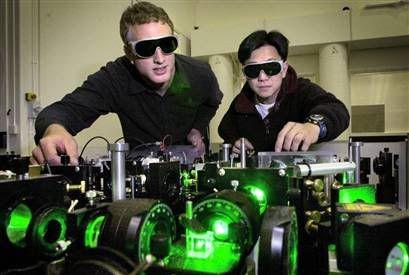
The ability to transfer properties of one particle to another without using any physical link has been achieved with laser light. When physicists talk about "teleportation", they are describing the transfer of "quantum states" between separate atoms. Being able to do the same with massive particles like atoms could lead to new superfast computers.

Achievements


So far, physicists have been successful in teleporting particles of light (photons), individual atoms of Caesium (Cs) and Beryllium (Be) up to 100 miles. The next phase is to teleport an atom through the vacuum of space. In a few decades, we may be able to send a molecule, DNA, a virus, or even a living cell. This development is a long way from the transporters seen in Star Trek. We need to wait a few more centuries.

Note: An average human adult body is made up of 50~100 trillion cells.

Our assumption

The classical idea of teleportation is the one method that we are used to. An object disassembles into particles, excites those particles and transfers them at high speeds, then reach the location and each individual particle reassembles back to form a complete object. Which is almost impossible, seeing that the process would required exponentially huge amount of energy, and it's time consuming.

The real thing

What physicists are applying is something known as Quantum teleportation. Each particles in an object has it's own counterparts that have the same properties but also exist in a different space. This is called the Entanglement phenomenon, one of the weirdest scientific mysteries. So in theory, we actually transfer the information of a particle such as temperature, mass, colour, etc.
Quantum entanglement is a quantum mechanical phenomenon in which the quantum states of two or more objects are linked together so that one object can no longer be adequately described without full mention of its counterpart — even though the individual objects may be spatially separated.

Try to imagine

Two electrons exist in different locations but exist in the same frequency, hence they are essentially identical. Like two balls attached to a vibrating string, except one ball that you are holding is "Real" and the ball at the other end is "Imaginary". When you destroy the "Real" ball, the information from the "Real" ball is tranferred to the "Imaginary" ball via the vibrating string. Thus the "Imaginary" ball is now an exact copy of the "Real" ball.

At first, it may sound a photo-copying. But the original does not exist anymore.
The "Imaginary" ball before is now becomes the "Real" ball.


Teleporting an apple with near-impossible even with the Quantum entanglement stuff.
The best with could do is to teleport small amount of data via photons. Let's assume we have achieved Quantum teleportation for human beings. You can teleport from home to office.

Now here's the catch

Ask yourself, are you still you? After you teleport, you're not in your original body anymore, because the original copy is destroyed. You may feel and think the same but your atomic make-up is different. Are you still human when your body is not the original? Can consciousness be teleported? More food for thought.

Personal thoughts

I would like to see the day when I could go to different places in a blink of an eye, but that would not happen in our lifetime. Though I may not be able to experience teleportation, I'm proud to belong to the generation that invented it. Ok, beam me up. Scottie!

Short videos:
http://www.youtube.com/watch?v=3nq6y9P1_yM
http://www.youtube.com/watch?v=G5poD3nXdJ8

... continue reading