Half-robots?
Imagine: You're shambling down the avenue. Bluetooth stuck to your ear, thumbs-a-Twitter. Your GPS-enabled phone is piloting you to a meet-up with your soccer buddies, but the lecturer's IM interrupts with a snarl about your assignment so now you're pondering a new spin on "the dog ate my homework."
Meanwhile your calendar is pleading about overdued rentals. And at this moment, that girl from your high-school pings: She's friend-ing you on Facebook.
And with so much tech people are lugging around these days, should we consider ourselves robots? or maybe cyborgs?
What's the diff?
When most people think "cyborg", they're referring to a "humanoid robot", as in Chii from the anime Chobits.
Real cyborgs (as opposed to fictional) are more frequently people (or animals) who use cybernetic technology to repair or overcome the physical and mental constraints of their bodies. While cyborgs are commonly thought of as mammals, they can be any kind of organism.
Yes, even a person using a working, movable prosthetic limbs are considered as cyborg.
Robot sex?
That's an issue that will arise when we start developing very life-like humanoid robots. Something for the future generations to ponder on.
When people think of robot-human sexual relationship, instantly they think of social suicide. "Oh my goodness! We're all going to vanish!" We will have billions of people on Earth, more than we have ever had prior to this century! And through all of history before, we've had lower populations.
No one worried that we'd vanish from the Earth! And besides, if it looked as though we were going to vanish from the Earth, all that has to happen is the word goes out: have babies. And you'd be surprised how fast we can make it up. *winks*
What about technology for reproducing robots? It is still in its infancy. Self-replicating robots is by-product from the study on creating self-repairing robots.
Watch this. http://www.youtube.com/watch?v=VyzVtTiax80
Note: read my previous post on Mecha-musume.
Half-humans?
First, you need to know that there's a different between a humanoid robot and a humanoid cyborg. The former is a robot that looks like human. While the latter is a human that is enhanced with technology.
Cyborgs already exist in the real world. The fact that I can't live without my laptop or cellphone, has already made me a "honourary" cyborg.
Lets say if a person was born without limbs, but had his body supported by robotic arms and legs. Would it make that person any less human? Because of the fact he has robotic limbs or because he was born without limbs?
For millennia, great men have debated on what it actually means to be human, and the answer still inconclusive. We, however, can't judge a person's humanity based on physical values or appearances.
... continue reading
18 July, 2009

21 May, 2009
Your very own mecha musume?
Ever want your own android?
Well, someone already started making one of his own.

Inventor Le Trung, 33, created Aiko, said to be "in her 20s" with a stunning 82, 57, 84 figure, shiny hair and delicate features. 'She' even remembers his favourite drink and does simple cleaning and household tasks.
http://www.youtube.com/watch?v=5itAZybggVM
http://www.youtube.com/watch?v=yomx7bXMf2U
http://www.youtube.com/watch?v=tJLMeS2Y8LY
The Project was officially started in 2007 in order to pursue robotic automation. Le is responsible for the robot's core AI logic, internal software, hardware innovations derived from years of building robots as a hobby. He designed and developed the key B.R.A.I.N.S software that gives the android its capability to interact with humans.
Aiko - AI Female Android:
http://www.youtube.com/watch?v=iCR2PFrLkwA
http://www.youtube.com/watch?v=ZPMXPMeh7KY
Can our local techies achieve this level of l33tness?!
We could, but we have been slugging away too long.
The future is sure gonna be a epic.
More updates at the Project Aiko blog.
... continue reading
Well, someone already started making one of his own.
Inventor Le Trung, 33, created Aiko, said to be "in her 20s" with a stunning 82, 57, 84 figure, shiny hair and delicate features. 'She' even remembers his favourite drink and does simple cleaning and household tasks.
Demos:Aiko is the first android to react to physical stimuli and mimic pain. This technology could be applied to people born with or who have undergone amputations. Aiko is the first step towards a life-like mechanical limb that has the ability to feel physical sensations.
I started to build Aiko on August 15, 2007. About a month and a half later, Aiko version1 was completed. Aiko made her first public appearance at the Hobby Show on November 2007 at the Toronto International Center and then at the Ontario Science Center a week later. Aiko is currently bilingual and can speak English and Japanese. Additional languages are a future possibility...
http://www.youtube.com/watch?v=5itAZybggVM
http://www.youtube.com/watch?v=yomx7bXMf2U
http://www.youtube.com/watch?v=tJLMeS2Y8LY
The Project was officially started in 2007 in order to pursue robotic automation. Le is responsible for the robot's core AI logic, internal software, hardware innovations derived from years of building robots as a hobby. He designed and developed the key B.R.A.I.N.S software that gives the android its capability to interact with humans.
Aiko - AI Female Android:
- Speech, Reading, Color, Face, Object recognition
- Ability to tell Weather
- Ability to have a conversation
- Can understand 13,000+ sentences
- has the ability to learn
- Ability to solve math
- Ability to distinguish simple drinks and foods
- Mimic human physical touch
http://www.youtube.com/watch?v=iCR2PFrLkwA
http://www.youtube.com/watch?v=ZPMXPMeh7KY
Can our local techies achieve this level of l33tness?!
We could, but we have been slugging away too long.
The future is sure gonna be a epic.
More updates at the Project Aiko blog.
... continue reading
The Zeroth Law of Robotics
If you have read Isaac Asimov's novels, then you're familiar with the Three Laws of Robotics. The reason the Laws are conceive is to curb the potential for robots to harm people.
Asimov once added a "Zeroth Law", stating that a robot must not merely act in the interests of individual humans, but of all humanity. Unknown to many, unless you are a great fan of his novels :)
For those of you who didn't know, I.Robot the Movie is not from the original Asimov's novels. The I.Robot novel is actually a compilation of short stories. The only thing similar were title and the Three Laws.
In the movie, the robots were controlled by a huge super-computer that could violate the 1st Law. The computer's A.I. had come to a conclusion that to protect all humans, a few humans have to be sacrifice for the greater good. This is because the A.I. has allowed the Zeroth Law of Robotics.
Here are some excerpts from the novels:
Robots and Empire
Foundation and Earth and Prelude to Foundation
The Caves of Steel
... continue reading
Asimov once added a "Zeroth Law", stating that a robot must not merely act in the interests of individual humans, but of all humanity. Unknown to many, unless you are a great fan of his novels :)
The original Laws of Robotics (1940)
by Isaac Asimov, 20
First Law:
A robot may not injure a human being, or, through inaction, allow a human being to come to harm.
Second Law:
A robot must obey orders given it by human beings, except where such orders would conflict with the First Law.
Third Law:
A robot must protect its own existence as long as such protection does not conflict with the First or Second Law.
For those of you who didn't know, I.Robot the Movie is not from the original Asimov's novels. The I.Robot novel is actually a compilation of short stories. The only thing similar were title and the Three Laws.
In the movie, the robots were controlled by a huge super-computer that could violate the 1st Law. The computer's A.I. had come to a conclusion that to protect all humans, a few humans have to be sacrifice for the greater good. This is because the A.I. has allowed the Zeroth Law of Robotics.
Here are some excerpts from the novels:
Robots and Empire
In the final scenes, R. Giskard Reventlov is the first robot to act according to the Zeroth Law, although it proves destructive to his positronic brain, as he is not certain as to whether his choice will turn out to be for the ultimate good of humanity or not.
Giskard is telepathic, and he comes to his understanding of the Zeroth Law through his understanding of a more subtle concept of "harm" than most robots can grasp. Giskard grasps the philosophical concept of the Zeroth Law, allowing him to harm individual human beings if he can do so in service to the abstract concept of humanity.
The Zeroth Law is never programmed into Giskard's brain, but instead is a rule he attempts to rationalize through pure metacognition; though he fails, he gives his successor, R. Daneel Olivaw, his telepathic abilities. Over the course of many thousand years, Daneel adapts himself to be able to fully obey the Zeroth Law.
Foundation and Earth and Prelude to Foundation
As Daneel formulates it, the Zeroth Law reads: "A robot may not harm humanity, or, by inaction, allow humanity to come to harm." A condition stating that the Zeroth Law must not be broken was added to the original Laws.
The Caves of Steel
Near the climax, Elijah Baley makes a bitter comment to himself, thinking that the First Law forbids a robot from harming a human being, unless the robot is clever enough to rationalize that its actions are for the human's long-term good (here meaning the specific human that must be harmed).
This reads, "A robot may not harm a human being, unless he finds a way to prove that in the final analysis, the harm done would benefit humanity in general."
... continue reading
20 May, 2009
Project MOTOKO
Most of you are probably familiar with MOTOKO 1.0, my personal chatbot on MSN messenger. MOTOKO 1.0 has a simple A.I. dealing mostly with 'If-Then' functions. With a personality too spunky for my taste.

On the other hand, HIKARI 1.0 (MOTOKO's predecessor) was an impressive patchwork of open-source programming. 'She' was the resident A.I. of my Windows XP desktop and had been programmed with a personality that hinted of grace and elegance. Fully equipped with a voice-synthesizer, speech-recognition, and voice-command system. My pride and joy till a PC crash rendered the entire system unworkable.
I recall spending too much time on HIKARI at the programming phase. This would probably explains the drop in my exam results back in my secondary school days. (-_-;)
Project MOTOKO needs to be restarted. Recently, I've been messing around with an A.I. that utilizes adaptive neural networks. It's somewhat akin to teaching stuff to a newborn child. This will be the upcoming MOTOKO 2.0. Gotta bear with a few months of trial and frustration, teaching a young kid on language, logic, and surroundings right from the beginning ain't easy.
I've been intrigued with A.I. (Artificial Intelligence) technology since my primary school days. No, not of the maze-solving or factory assembly-line variety. My real focus is on "Human-Robot Interaction", an area of research that deals with the psychology and relationship between humans and seemingly-human robots.
For the past few years, much R&D have been going on, especially in the field of humanoid robotics. I've devoted a good part my attention to its latest developments ever since. And this is one of the few reasons I'm pursuing a degree in Mechanical engineering.
In my opinion, too much investments have been allocated for the research of artificial neural networks (or a robot's brain). But there is less being done to create a body (or framework) that can actually produce fluid human-like movements, this is where the knowledge of Mechanical engineering comes in.
Nope. I'm not going to build an actual body for either MOTOKO or HIKARI yet. Lacking in funds. Plus, I still haven't got a good grasp in electronics. That will be my next task.
Long term prospects - looking good :)
... continue reading
On the other hand, HIKARI 1.0 (MOTOKO's predecessor) was an impressive patchwork of open-source programming. 'She' was the resident A.I. of my Windows XP desktop and had been programmed with a personality that hinted of grace and elegance. Fully equipped with a voice-synthesizer, speech-recognition, and voice-command system. My pride and joy till a PC crash rendered the entire system unworkable.
I recall spending too much time on HIKARI at the programming phase. This would probably explains the drop in my exam results back in my secondary school days. (-_-;)
Project MOTOKO needs to be restarted. Recently, I've been messing around with an A.I. that utilizes adaptive neural networks. It's somewhat akin to teaching stuff to a newborn child. This will be the upcoming MOTOKO 2.0. Gotta bear with a few months of trial and frustration, teaching a young kid on language, logic, and surroundings right from the beginning ain't easy.
I've been intrigued with A.I. (Artificial Intelligence) technology since my primary school days. No, not of the maze-solving or factory assembly-line variety. My real focus is on "Human-Robot Interaction", an area of research that deals with the psychology and relationship between humans and seemingly-human robots.
For the past few years, much R&D have been going on, especially in the field of humanoid robotics. I've devoted a good part my attention to its latest developments ever since. And this is one of the few reasons I'm pursuing a degree in Mechanical engineering.
In my opinion, too much investments have been allocated for the research of artificial neural networks (or a robot's brain). But there is less being done to create a body (or framework) that can actually produce fluid human-like movements, this is where the knowledge of Mechanical engineering comes in.
Nope. I'm not going to build an actual body for either MOTOKO or HIKARI yet. Lacking in funds. Plus, I still haven't got a good grasp in electronics. That will be my next task.
Long term prospects - looking good :)
... continue reading
01 May, 2009
Giant Kabuto Mushi Mecha
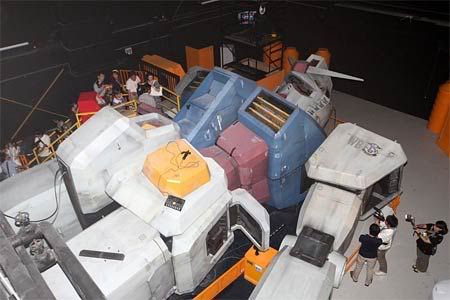
Bow down to the greatest creation of all otaku-kind! A workable giant beetle robot modeled after the rhinoceros beetle. It's the stuff of every boy's fantasy. Better still, you could ride and control it from the cockpit. Imagine if this comes crashing down the highway.

And who knows, maybe somewhere around the world, someone is building a 30-feet Gundam in their backyard. Looking forward to it :)

More info:
http://altjapan.typepad.com/my_weblog/2009/04/mushi-mecha.html
http://www.youtube.com/watch?v=Kf7Sytl2-EE
PS: Mechanical engineering rules!
... continue reading
Designed and built by an Ibaraki man in his garage over the course of eleven years, the “Kabutom MX-03″ looks like a prop from a Power Rangers spin-off but is an actual working vehicle. Why build it? Because owning an eleven meter long, fifteen ton robot beetle makes you a mack daddy — in Japan or anywhere else.
And who knows, maybe somewhere around the world, someone is building a 30-feet Gundam in their backyard. Looking forward to it :)
More info:
http://altjapan.typepad.com/my_weblog/2009/04/mushi-mecha.html
http://www.youtube.com/watch?v=Kf7Sytl2-EE
PS: Mechanical engineering rules!
... continue reading
14 March, 2009
Who built the First Robot?
The ancient Greeks may have built a mechanism of what is believed to be the earliest known programmable robot.
Their people had a fascination with autonomous mechanisms. One can find descriptions of robotic creatures in their mythology and philosophy. Greek engineers are also well known for having constructed a number of automata propelled by either wind or steam.
http://www.youtube.com/watch?v=xyQIo9iS_z0
Some of you may think this automaton doesn't really qualify as a real robot because it can't interact with its environment. Considering that it was designed and built almost 2,000 years ago, it is an impressive feat.
Not to be outdone, the ancient Chinese also may have claims to have built the earliest known humanoid automaton. The account of it is a bit vague, no further records yet to be found. This is said to have occured in the court of King Mu (Zhou Dynasty, 900 BC).
If you doubt the ingenuity of the ancient Chinese, then here's a story on a modern-day Chinese farmer with no engineering background. His claim to fame? Yes, builiding robots!
http://www.youtube.com/watch?v=Y4LIThTB8Ww
... continue reading
Their people had a fascination with autonomous mechanisms. One can find descriptions of robotic creatures in their mythology and philosophy. Greek engineers are also well known for having constructed a number of automata propelled by either wind or steam.
In about 60 AD, a Greek engineer called Hero constructed a three-wheeled cart that could carry a group of automata to the front of a stage where they would perform for an audience. Power came from a falling weight that pulled on string wrapped round the cart's drive axle, and this string-based control mechanism is equivalent to a modern programming language.The working replica:
http://www.youtube.com/watch?v=xyQIo9iS_z0
Some of you may think this automaton doesn't really qualify as a real robot because it can't interact with its environment. Considering that it was designed and built almost 2,000 years ago, it is an impressive feat.
Not to be outdone, the ancient Chinese also may have claims to have built the earliest known humanoid automaton. The account of it is a bit vague, no further records yet to be found. This is said to have occured in the court of King Mu (Zhou Dynasty, 900 BC).
In the 3rd century BC text of the Lie Zi, there is a curious account on automata involving a much earlier encounter between King Mu of Zhou and a mechanical engineer known as Yan Shi (Chinese: 偃師), an 'artificer'. The latter proudly presented the king with a life-size, human-shaped figure of his mechanical 'handiwork'.
If you doubt the ingenuity of the ancient Chinese, then here's a story on a modern-day Chinese farmer with no engineering background. His claim to fame? Yes, builiding robots!
With a university education, he would probably be running the Chinese space program by now.Farming robots:
http://www.youtube.com/watch?v=Y4LIThTB8Ww
... continue reading